
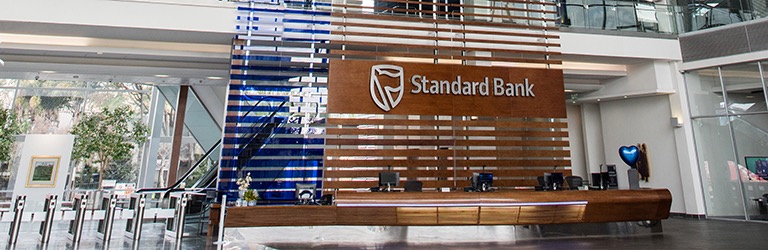
How Standard Bank turns real estate into a competitive advantage
At Standard Bank, real estate is seen as a growth lever. This is the story of how the bank’s Real Estate Services team is building the platform for Africa’s future – one building at a time.
When municipal water supply recently failed at Standard Bank’s Simmonds Street complex in Johannesburg’s CBD, where up to 5,000 people work each day, the building didn’t miss a beat.
For three weeks, borehole water kept the critical complex operational, with staff and clients none the wiser about the disruption. That was the point, says Nkosinathi Manzana, Executive Head of Group Real Estate at Standard Bank.
“Our role is to ensure that business doesn’t see or feel any of those challenges in our buildings. The priority is to ensure that we have adequate resilience to guarantee business continuity,” he tells Asset.
That distinction – between reacting to problems and ensuring business never stops – captures the transformation underway at Standard Bank’s Real Estate Services (RES).
The team of real estate professionals does more than manage Standard Bank’s real estate portfolio of corporate offices and retail points of representation across 21 Sub-Saharan countries. They are building the physical, sustainable and employee offering that lets Africa’s largest bank (by assets) serve clients, grow in priority markets and keep critical operations resilient.
Real estate as strategic infrastructure
At Standard Bank, the real estate portfolio is not just where business happens – it is a strategic advantage that helps power growth across Africa.
“Quite simply, RES manages every aspect of properties that we use for business – retail branches, offices and the entire value chain – from there being nothing on the ground to either signing up a lease for a new building, or overseeing the process of developing a new building across all countries, including ongoing operations and management,” Nkosinathi explains.
The scale is significant. In South Africa alone, the portfolio spans just under half a million square metres; across the continent, it’s approaching a million square metres of real estate.
Managing a portfolio of this scale requires deliberate choices about where the bank invests, how it enables its people, and how it builds resilience for the future. To manage this complexity, RES has organised its work around five strategic choices: workplace experience, workplace enablement, building resilience, portfolio management and sustainability, underpinned by two enablers – Artificial Intelligence (AI) and operational excellence.
Enabling growth across Africa’s markets
The strategy starts with a fundamental recognition: Africa is not a single market and real estate decisions must reflect local realities. After all, the 21 countries across the continent that Standard Bank is exposed to are not homogeneous; they have unique challenges and are at different stages of development, requiring a tailored approach.
That principle is visible in the bank’s current capital projects across the continent.
In Zimbabwe, the new Stanbic head office in Harare’s Borrowdale suburb is on track to become the country’s first net-zero commercial facility. The three-level project is scheduled for completion by December 2026.
In Nigeria, the Stanbic IBTC Towers on Victoria Island stands as a flagship head office – and was the first Green Star-rated building in the country when completed in December 2023.
In Kenya, Project Imara is advancing a new headquarters as part of RES’s 2026 delivery focus. In Mozambique, Standard Bank has a seven-floor glass-fronted headquarters in Maputo, launched in 2012. Côte d’Ivoire is another live project.
“Our countries are in different phases of maturity or growth – some are growing rapidly, others are maintaining, and others are plateauing,” says Janice Moodley, Head of Business Strategy at Standard Bank’s RES. “We have to adapt to those conditions by working closely with the country-specific business lines.”
This isn’t just about putting up buildings. It’s about following the growth strategy of Standard Bank at a group level. “If there is significant business growth in Nigeria, and we end up employing more people, we might end up taking another lease or building another office, but it must always be in line with business,” Janice says.
Cost discipline and the save-to-invest philosophy
Over time, RES has taken deliberate steps to optimise the portfolio, creating capacity to reinvest in initiatives that enhance client experience, employee productivity and long-term resilience. In doing so, the team helped reduce the bank’s real estate portfolio by circa 20% between 2020 and 2025.
The rationale was not simply cost-cutting; it was about releasing capital and operating cost to reinvest where it matters.
“We adopt the save-to-invest philosophy,” Nkosinathi explains.
The numbers tell the story. In 2026, RES is targeting direct cost growth that is below inflation – a remarkable achievement given the relentless pressure of utility tariff hikes and rental escalations. The discipline flows from a ‘save-to-invest’ philosophy: energy efficiency initiatives alone are delivering R22.5 million in savings, while 8,924 kWp of installed solar capacity across the portfolio shields the bank from grid volatility and rising power costs.
That discipline is guided by data. Utilisation insights – tracking occupancy patterns and space usage across the portfolio – guide RES’s decisions on where to consolidate, repurpose or invest, ensuring that every square metre supports business demand rather than dragging on costs.
Client trust through physical presence
In an increasingly digital world, physical presence remains an important component of Standard Bank’s distribution strategy across many African markets. While the Group business determines where and how the bank should serve clients, RES partners closely with the Personal and Business Banking teams to translate that strategy into reality through the delivery of innovative, sustainable, purpose-built physical points of representation.
From new branches and formats to innovative service points, RES provides the real estate expertise, delivery capability and operational execution required to bring the bank’s distribution ambitions to life. “RES is helping Standard Bank meet clients where growth is happening: translating the bank’s distribution strategy into physical presence in the locations and communities where clients need us most,” says Janice.
Employee experience and productivity
The workplace is no longer just where work happens; it plays an important role in attracting and retaining talent. And high-quality buildings don’t just feel nice, says Nkosinathi. “They also measurably boost how well people work.”
RES measures this through its ‘Rate My Workplace’ tool, which achieved an 88% average score in May 2026 against an 80% target. Average peak office occupancy in South Africa is 64%, significantly outperforming the 36% Europe, the Middle East and Africa benchmark, while several key buildings are approaching pre-Covid pandemic occupancy levels, even with hybrid work policies. This reflects the value employees continue to place on high-quality workplace environments.
The post-Covid workplace has demanded a fundamental rethink. While employees have largely returned to the office, the way they work has changed significantly. Hybrid meetings have become the norm, with colleagues often joining the same meeting from different locations – or even from different spaces within adjacent buildings. This has created new demands on workplace design, from ensuring adequate privacy for virtual conversations to providing the technology, acoustic treatments and network capacity needed to support seamless collaboration. “The workplace is no longer just about accommodating people at desks,” says Nkosinathi. “It needs to support a mix of in-person and virtual interactions, while still providing a productive and engaging experience for everyone.”
RES has responded by converting over 90% of meeting rooms in SA to support hybrid work – one-touch technology that connects remote and in-person participants seamlessly. The design philosophy has shifted from one-size-fits-all to activity-based settings. “In the design process, we integrate the views of the particular business unit. So, a marketing floor is not going to look the same as an investment banking floor,” says Nkosinathi.
The bank is now moving beyond functional enablement to what Nkosinathi calls “workplace experience” – how the space makes people feel. “It’s for both our staff and our visitors,” he says. As part of its focus on workplace experience, RES has partnered with a third party to explore how workplace design influences employee behaviour, collaboration and performance. Through a Social Spatial design assessment, the team is testing how different workplace settings support connection, productivity and overall employee experience, creating a data-driven foundation for future workplace decisions.
“Better workplaces enable better performance, allowing teams to focus on clients and outcomes,” he says.
Resilience, sustainability and future readiness
Perhaps nowhere is the shift from proactive to predictive more visible than in building resilience. The approach involves leveraging AI and enhanced sensor technology to predict failures before they occur. For RES, resilience means ensuring that disruptions to power, water or infrastructure do not disrupt the bank’s ability to serve clients, support employees and generate revenue. The measure of success is not whether an incident occurs, but whether the business feels its impact. In May 2026, Standard Bank’s Tier 1 facilities (the bank’s highest-priority, most critical buildings) recorded 100% uptime, exceeding their 99.95% target. In other words, the bank’s most vital buildings stayed operational even when public infrastructure did not.
The approach to sustainability mirrors this resilience mindset. RES has set clear targets: all new buildings must achieve net zero by 2030, and existing buildings by 2040. The Standard Bank Group is approximately 4 years ahead of its target to achieve net zero by 2040 for scope 1 and scope 2 emissions.
The bank’s Zimbabwe head office has already achieved Net Zero (Modelled) certification from the Green Building Council of South Africa. In Namibia, Standard Bank built the first Green Star-rated building in the country. In Nigeria, the head office was the first Green Star-rated building in that market.
Beyond environmental sustainability, RES has pioneered workplace wellness. In 2025, Standard Bank became the first Africa-based financial institution to achieve the WELL Health-Safety Rating across 15 corporate buildings, covering 353,000m² in South Africa. “It’s a promise that everyone who enters our buildings will experience a space that’s safe, healthy and welcoming,” Nkosinathi says of the WELL recognition. “We have scaled this further to 29 buildings.”
The technology edge
The excellence recognition doesn’t end there.
In 2026, Standard Bank was awarded the Realcomm Digie Award for best use of automation in corporate real estate – alongside Cisco and Alaska Airlines – and was the only African organisation represented. The award recognised two automation tools: one that uses AI to streamline document compliance, and another that scans utility bills and extracts the data the bank needs to track energy use and costs. “The solution automates the extraction and analysis of utility data, providing timely insights that support both sustainability decision-making and financial oversight,” Nkosinathi explains.
AI adoption is now a core component of the RES strategy, which encourages the use of AI tools such as Microsoft Copilot in day-to-day activities. By embedding AI into everyday workflows, RES aims to drive smarter decision-making, greater efficiency and continuous innovation.
The bigger picture
For Nkosinathi, success begins with being embedded at the heart of the business. RES creates the most value when it is close enough to understand the bank’s ambitions, anticipate its needs and translate strategy into the spaces, infrastructure and experiences that enable delivery.
That embeddedness extends across the continent. Janice believes the future of RES lies in moving beyond optimisation to actively shaping the bank’s growth journey, ensuring that the right infrastructure, workplaces and capabilities are in place to support growth, wherever the business chooses to compete.
Nkosinathi believes the pace of change will only accelerate over the next decade. As climate-related disruptions become more frequent and technology continues to reshape the workplace, resilience, automation and digital enablement will become fundamental to how real estate creates value. The RES team of the future will be increasingly defined by data, technology and innovation, with digital capabilities embedded into every aspect of its work.