

Stable domestic demand, shifting international travel amid rising airfares and global disruption – Standard Bank data
The conflict in the Middle East has disrupted air travel. Some estimates point to a drop of up to 30% in arrivals to the Middle East. But the impact is not limited to that region.
In South Africa, air fares have risen due to fuel surcharges resulting from the increase in jet fuel prices which doubled between February and April. This has led to local and international airlines increasing fuel surcharges and, in some instances, reducing flight frequencies. This has made air travel more costly for consumers.
Despite these pressures, Standard Bank Travel data indicates that domestic travel demand among its clients remained broadly stable over the period analysed.
The bank analysed bookings on its travel platform. It compared activity before fuel surcharges, introduced on 12 March, with bookings from 12 March to 4 May 2026.
“We expected some reduction in air travel due to higher fares,” says Michelle Munemo, Head of Travel & Lifestyle Propositions at Standard Bank SA. “But demand on key local routes stayed strong among our clients. That said, our data reflects activity of our clients only, not the full market.”
Munemo adds that Standard Bank Travel’s discounts of up to 40% on the base fare of flights coincided with continued domestic demand. “We know many South Africans still want to travel, and we’ve supported that demand by offering meaningful discounts on top of transparent base fares. “We have aimed to ensure our pricing remains aligned to underlying airline fares, where such fares are made available to us through our travel and distribution partners.”
Domestic demand stays firm
More than 73% of bookings since mid-March have been domestic. Johannesburg remained the top domestic destination. Cape Town ranked second, followed by Durban, Gqeberha and George. This ranking stayed the same before and after the airline fuel surcharges.
Average monthly bookings to Johannesburg rose by more than 8% between 12 March and 4 May, the period after most airlines increased their fuel surcharges. Cape Town increased by 2%. Durban grew by 4.8%. But it was George that saw the biggest increase in the number of average flights booked during this period followed by Bloemfontein. East London and Gqebera saw a slight decrease in average monthly volumes.
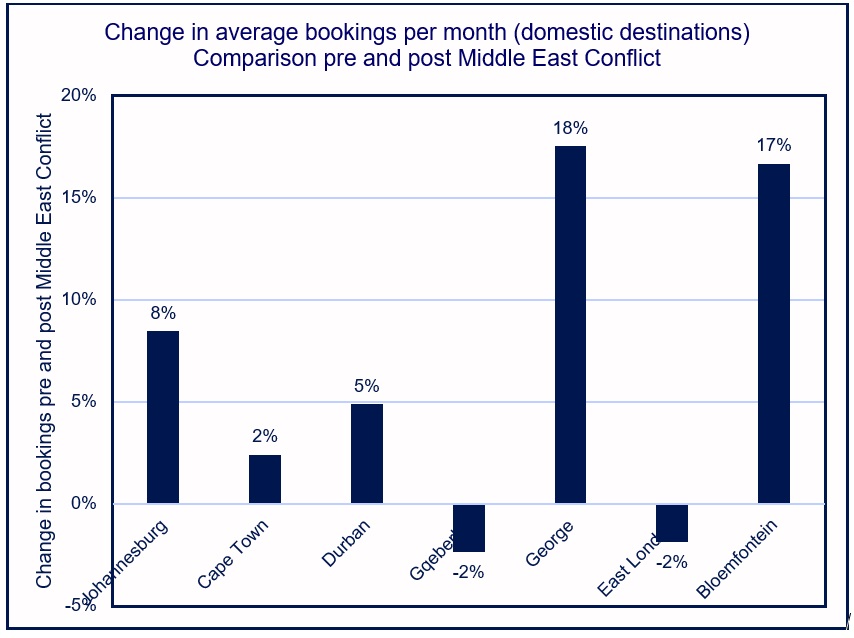
Source: Standard Bank - This data reflects confirmed bookings made via the Standard Bank Travel platform before the conflict (18 October 2025 to 11 March 2026) and after the conflict (12 March 2026 to 4 May 2026).
Beyond the numbers, the data reflects a broader behavioural shift among travellers. Domestic travel is increasingly being used for shorter, more frequent trips, with a growing preference for weekend getaways, family visits, and event-driven travel.
Clients are increasingly booking travel further in advance to secure better fares, particularly on high-demand domestic routes.
This reflects a broader shift in travel behaviour, where pricing changes are influencing not only destination choice but also when people choose to travel.
The international picture changed more
While domestic travel remained stable, international travel showed significant sensitivity to geopolitical and cost pressures. London stayed the top international destination. As expected, travel to Dubai, declined sharply after the Middle East conflict escalated and flight disruptions increased. Average bookings per month to Dubai fell by 67% between February and March.
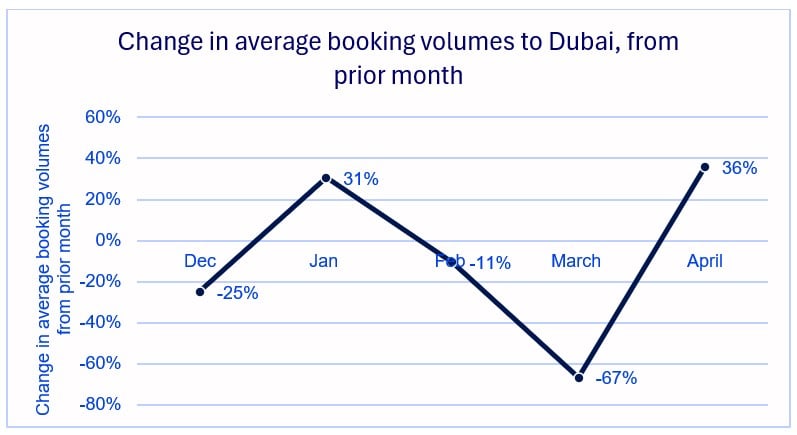
Source: Standard Bank - Data reflects confirmed bookings made via Standard Bank Travel platform from October 2025 to April 2026.
Following this shift, Dubai moved from the second most popular international destination to sixth place by early May. Harare, Amsterdam and Paris increased in relative ranking during the same period.
Rather than a full reduction in international travel, the data suggests more selective and considered decision-making, with travellers prioritising destinations perceived as more stable in both cost and availability.
“This decline reflects geopolitical risk in the Middle East,” says Munemo. “At the same time, higher costs are shaping decisions. Domestic travel already led activity before the Iran war, but recent events have pushed demand further towards local trips Current trends suggest continued strength in domestic demand, though this may evolve as pricing stabilises and clients balance the cost of travel with their desire to travel. It is likely that clients will take more domestic trips than international trips and book their travel further in advance until the cost of air travel stabilises.”
Pricing and value impact
Munemo notes that discounts on Standard Bank Travel may also support group travel, as Standard Bank clients are able to extend the same discounted fares to family and friends when they are included in a booking.
“If our discounts have helped clients continue leisure travel despite rising costs, then the platform is delivering real value, and that’s what we promised to give our clients when we launched it,” she concludes.