
Built in Africa: Why Africa’s biggest growth opportunity is now Africa itself
For decades, Africa's growth story was defined by how successfully the continent connected with the rest of the world. Capital, customers and trade opportunities were often sought beyond our borders, with success measured by access to markets in Europe, Asia and North America.
That picture is beginning to change.
Today, Standard Bank’s Business & Commercial Banking clients trade more with businesses across Africa than with any single external market, including China, the United States or the European Union. It is a shift that reflects something far more significant than changing trade patterns. It signals a structural transformation in how African businesses are growing, investing and creating value across the continent.
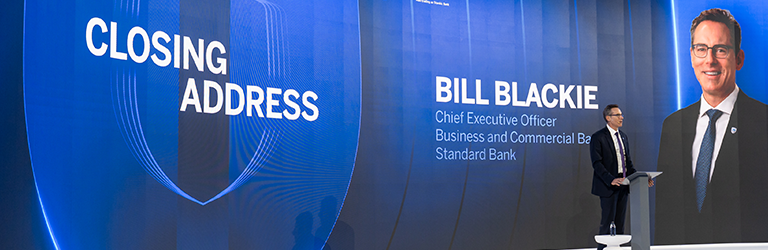
It is also the central message behind this year’s Africa Unlocked conference, where business leaders, investors and policymakers gathered under the theme Built in Africa: Amplifying Continental Growth.
“Africa’s moment is not coming,” says Bill Blackie, Chief Executive of Business & Commercial Banking at Standard Bank. “It is already here.”
That confidence is grounded not in optimism alone, but in what businesses across the continent are already achieving.
Earlier this year, while visiting East Africa, Blackie met one of Standard Bank’s clients, Coast Cables. Founded in 1978 as a manufacturer of super-enamelled copper wire, the company has grown into a regional producer of domestic and industrial power cables and is now expanding into solar energy.
What impressed him most was not simply the scale of the business, but the conviction behind it.
Despite navigating economic cycles, currency volatility and infrastructure constraints, the company continued investing and expanding.
As Blackie prepared to leave, the owner reflected on decades of building the business.
“If I knew then what I know now,” he told Blackie, “I would have invested 100% of my capital in East Africa.”
For Blackie, that sentiment captures a broader shift taking place across the continent: African businesses are increasingly placing their confidence in Africa itself and the numbers support that view.
Africa is expected to grow by almost 4% this year, while intra-African trade is forecast to increase by more than 12%. Pension assets across the continent now exceed US$1 trillion, creating deeper pools of domestic capital capable of supporting long-term investment.
Yet the most compelling evidence is found not in macroeconomic data, but in the businesses themselves.
Two years ago, Africa Unlocked heard from Adrian Basson, CEO of Hungry Lion, who shared the company’s ambition of opening 100 new stores a year across Africa.
Today, that ambition has become reality.
Hungry Lion has opened more than 500 stores across nine countries, employs over 10 000 people and is on track to open another 250 outlets this year alone.
Stories like these reinforce an important reality: growth rarely happens in isolation.
Standard Bank increasingly views successful businesses as part of interconnected ecosystems comprising suppliers, logistics providers, manufacturers, distributors and financiers.
That philosophy is clearly visible in Nigeria, where Standard Bank supports more than 300 businesses operating within the Dangote Petroleum Refinery value chain.
Rather than financing a single project, the bank supports the broader ecosystem that enables the refinery to operate and expand.
“The real opportunity lies in understanding the networks around our clients,” says Blackie. “When we support those relationships, we help value move across borders, sectors and every stage of growth.”
The same pattern is emerging across manufacturing and international trade. African businesses are moving beyond exporting raw materials towards producing higher-value products, while increasingly connecting directly with international markets.
A recent milestone in Standard Bank's 18-year partnership with ICBC illustrates this progress. Standard Bank became the first Africa-based institution authorised to clear renminbi transactions across 19 African countries.
The practical impact is significant. African businesses trading with China can now settle payments directly in renminbi through China’s Cross-Border Interbank Payment System, reducing costs and improving efficiency.
The results are already visible in sectors such as agriculture, where organically grown Kenyan coffee is now exported to China after being grown, processed and roasted in Africa.
Technology is creating similar opportunities closer to home. Blackie points to Calibre Engineering in Welkom, where financing enabled the business to import advanced manufacturing equipment from China.
The investment strengthened production capacity, improved operational efficiency and positioned the company to undertake increasingly complex engineering projects while creating employment and supporting skills development.
Energy presents another opportunity. Africa possesses around 60% of the world’s best solar resources, alongside many of the critical minerals needed for the global energy transition.
Since 2022, Standard Bank Business & Commercial Banking has mobilised more than R17 billion in green financing across Africa, supporting renewable energy and transition projects designed to power future economic growth.
For Blackie, however, the most important transformation extends beyond infrastructure, technology or finance.
It is a change in mindset.
Businesses are choosing to invest, expand and scale on the continent because they increasingly recognise Africa not simply as a market of potential, but as a market of opportunity.
“Amplifying continental growth is not where we’re going,” he says. “It is where we are today.”