Are you ready to export to China? What African businesses need to know
China offers significant opportunity for African exporters, but entering the market successfully requires far more than finding a buyer.
For businesses considering China, the first question should not be: “Who can I sell to?” It should be: “Can I reliably meet the requirements of the Chinese market?”
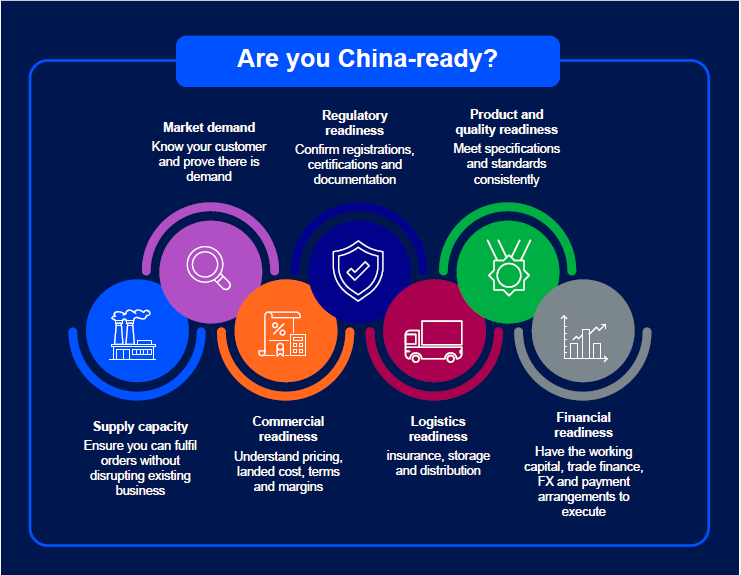
Export readiness means having the capability, compliance, capacity and commercial infrastructure to deliver consistently. A good product is important, but it is only one part of the equation.
Start with real demand
The size of the Chinese market should be viewed as an opportunity, not proof that demand exists for every product.
Businesses need to understand who their customer is, what competing products already exist, how their product will be positioned and priced, and which route to market is most appropriate. Direct engagement with credible buyers is valuable because it allows exporters to test their proposition against actual market requirements.
The objective is to move beyond “China is a large market” to a much more useful question: Who is my customer, what do they need, what will they pay and can I serve them reliably?
Make compliance an early priority
One of the biggest mistakes first-time exporters can make is treating regulatory compliance as something to address after securing a buyer.
Requirements vary according to the product and country of origin. For food and agricultural products, these may include registration with China's General Administration of Customs, food-safety and quarantine requirements, approved protocols, labelling requirements and other supporting documentation.
China's zero-tariff treatment for eligible African countries can improve the economics of an export transaction, but it does not remove regulatory obligations. Tariff access and regulatory market access are two different things. A product may attract no tariff and still need to meet all the relevant customs, safety, registration and product requirements before it can enter the market.
Adapt to the customer, not simply the market
Exporters should also avoid assuming that a product that performs well in Africa or another international market can be taken into China unchanged.
Depending on the customer and category, specifications, packaging, labelling, pack sizes, pricing or positioning may need to be adapted. The strongest approach is customer-led localisation: understand what the buyer requires while retaining the qualities that make the product distinctive and competitive.
Make sure success does not become a risk
Securing a large order can create its own problems if the business cannot deliver consistently.
Before accepting an order, exporters should assess production capacity, raw-material availability, lead times, quality-control processes, working capital and the ability to scale without compromising existing customers.
Consistency matters. Chinese buyers need confidence that the tenth shipment will meet the same standards as the first. Businesses should therefore stress-test their supply chains before demand increases.
Put simply, winning the order should not become the biggest operational risk to the business.
Know the true cost of exporting
Pricing must take account of more than production.
Packaging, inland transport, documentation, freight, insurance, customs-related charges, storage, distribution and, where relevant, cold-chain requirements all contribute to the true landed cost.
The critical commercial question is whether the product remains competitive while still delivering a sustainable margin once every cost has been accounted for.
Prepare financially before accepting the order
Exporters may need to pay for raw materials, production, packaging and logistics long before the buyer pays them.
Pre-export and trade finance can help fund that cycle, while appropriate payment structures can help manage counterparty risk. Businesses also need to understand their foreign-exchange exposure and, where relevant, the role RMB settlement can play in facilitating payments with Chinese buyers.
This is an area where Standard Bank, working with its partners and broader Africa-China ecosystem, can support clients through buyer matchmaking, trade finance, foreign exchange, payments and RMB capabilities.
Arrive ready to do business
A buyer meeting is not the place to start preparing.
Exporters should be ready to discuss their product proposition, capacity, certifications, quality standards, available volumes, lead times, pricing and proposed terms. They should also understand who the prospective buyer is and have a clear plan for what happens after the meeting.
The fundamental principle is simple: finding a buyer should be the beginning of the commercial conversation, not the beginning of the preparation.
The exporters best positioned to succeed in China will be those that have done the work before the opportunity arrives — and are ready to execute when it does.