
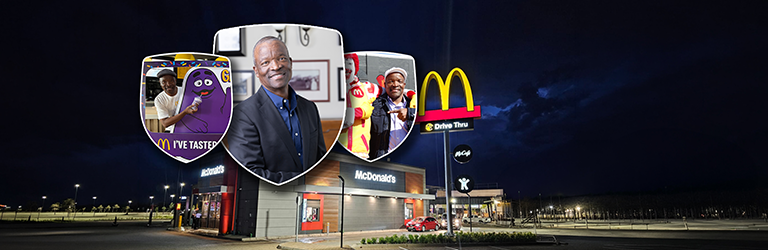
Learn how the young man who sold lollipops grew a burger business empire
Deep Dive Series | Article 3
Entrepreneurial powerhouse, Peter Moyanga turned childhood lessons into a lifetime of growth. Long before he owned 19 McDonald's restaurants, chaired industry bodies, helped shape franchising across Africa, or employed more than a thousand people, he was a schoolboy trying to solve a simple problem…
Fast-food tycoon Peter Moyanga when he recalled a key moment in his life. He wanted pocket money. His grandmother had a different idea.
One afternoon, instead of handing over a few coins, she gave him a bag of sugar. Together they melted it over an open fire, added lemon juice, rolled paper into moulds and created homemade lollipops. Then she handed them to him and delivered a lesson that would shape the rest of his life.
"There's your pocket money. Never ask me for money again," he says.
The next day he took the sweets to school. At first, he gave some away to friends. His grandmother was unimpressed. She wanted her sugar back. So, Peter started selling.
Soon, he was recruiting classmates, giving them inventory and rewarding them with commission. Years before he understood concepts such as distribution models, incentives and entrepreneurship, he was already building a sales network. That small venture became his first business. More importantly, it sparked a mindset that would define the rest of his journey.
The power of a dream
In 1981, while walking through Johannesburg with his uncle, Peter stumbled upon a newly opened fast-food restaurant. Its bright colours, spotless counters and bustling customer queues stopped him in his tracks. He was mesmerised. The restaurant was called Juicy Lucy. While everybody else saw a burger outlet, Peter saw possibility.
He watched customers stream through the doors and wondered how somebody built a business like that. Curiosity got the better of him. He approached the owner directly and asked how someone could own a business like this. The answer was simple: talk to the company that owns the brand.
For many people, the conversation would have ended there. For Peter, it became a lifelong ambition. "One day," he told himself, "I want to own a business like this."
Saving for prosperity
The dream needed funding. That meant discipline. After being retrenched from an early job, Peter found work at a furniture store. It was hardly glamorous. His first role involved sweeping floors and cleaning the showroom. He earned R37 a week. Most people would have focused on how little they earned. Peter focused on how much he could save. Inspired by another lesson from his grandmother, he adopted a philosophy he still talks about today: saving for prosperity.
Every week he deposited part of his salary into a bank account. When he earned a promotion and his income increased dramatically, he continued living modestly and saved the majority of the difference. As his earnings grew, so did his savings. His lifestyle improved gradually. His investment fund grew aggressively. And all the while, the dream remained the same. One day, he would own a business.
Breaking barriers
In 1987, Peter approached a restaurant franchise group about becoming a franchisee. The response reflected the realities of South Africa at the time. The opportunity was denied. Undeterred, he explored other avenues. The following year, through determination, partnerships and persistence, he secured an opportunity to open a Wimpy franchise. On 27 April 1988, Peter opened his first restaurant.
It was a milestone few would have imagined possible. But success brought a new challenge. Responsibility. When opening day excitement faded and the consultants left, Peter was suddenly alone with a fully operational restaurant. He recalls spending nights checking stock, analysing sales reports and preparing orders for the next day. He would work through the night, go home for a brief shower and return before the doors opened.
For months, he survived on just one or two hours of sleep a night. The intensity was exhausting. But it also taught him what it truly meant to own a business. Growth, he learned, is not glamorous. Growth is work.
From entrepreneur to corporate leader
After selling his first business, Peter moved into the corporate world. Eventually, he joined Pleasure Foods (which was subsequently acquired by Steers Holdings in 2003) as Franchise Development Manager, overseeing well-known brands including Wimpy, Milky Lane and Juicy Lucy. The role exposed him to franchising at scale. He travelled extensively, developed franchise networks and gained a deep understanding of what separated successful businesses from unsuccessful ones.
Then came a phone call that would change everything. A persistent caller from overseas wanted to meet him. Eventually, Peter agreed. The visitor represented a relatively unknown American company preparing to enter South Africa. That company was McDonald's. The opportunity offered was extraordinary. Help bring one of the world's biggest restaurant brands into South Africa.
At first, he was sceptical. He already had what many considered one of the best jobs in the country. But those around him urged him to consider the opportunity seriously. He listened. And in 1994, he began a journey with McDonald's that would shape the next chapter of his career.
Learning from the world's best
McDonald's invested heavily in Peter's development. He travelled internationally, studied systems, explored operations and immersed himself in the culture that had made McDonald's one of the world's most successful brands. He learned that sustainable growth was never accidental. It was built through systems. Training. Processes. Consistency. These attributes broadened his perspective and sharpened his understanding of what world-class business execution looked like.
For more than a decade, Peter helped build the McDonald's brand in South Africa. But deep down, he knew something. Corporate life was never the destination. Entrepreneurship was.
Returning to business ownership
By 2003, Peter was ready. McDonald's offered him an opportunity to acquire a restaurant in Springs. It felt like coming full circle. The young entrepreneur who had once dreamed of owning a fast-food business now had the chance to own a McDonald's franchise. On 1 August 2003, he took ownership of the Springs restaurant. From there, growth accelerated. One store became two. Two became three. Three became five.
Eventually, Peter became the largest single McDonald's franchisee in South Africa, owning 19 restaurants across multiple provinces. Today, after recently streamlining operations, he owns 14 McDonald's restaurants, employing more than 800 people. It is an extraordinary achievement. But for Peter, growth has never been measured solely by store numbers.
Building people, not just businesses
What’s interesting is that when Peter speaks about success, he rarely talks about revenue. Instead, he talks about opportunity. The thousands of people who have built careers within the McDonald's system. The managers who started at entry level. The families supported by stable employment. The young people who discovered pathways they otherwise may never have found. He believes franchising is one of the most powerful engines for economic empowerment and upward mobility.
It is a conviction that led him to dedicate years to the Franchise Association of South Africa, where he eventually became chairman. His work extended beyond South Africa's borders. Through educational programmes and workshops across Africa, he helped introduce entrepreneurs, policymakers and business leaders to the potential of franchising as a vehicle for economic growth. For Peter, business is never just about ownership. It is about creating opportunities for others.
Growth through trust
Every growth story includes defining moments. For Peter, one of those moments arrived shortly after buying his first McDonald's restaurant. An opportunity to acquire a second restaurant became available. There was only one problem. Funding. His existing bank was slow to make a decision and deadlines were running out. The opportunity was in danger of disappearing. In desperation, Peter reached out to Standard Bank.
Within days, the funding support he needed was approved and communicated. The deal was saved. More importantly, a relationship was born. Since then, every McDonald's acquisition that followed has been financed through that partnership. For Peter, the experience wasn't simply about accessing capital. It was about working with people who saw the opportunity and were willing to back his vision. And, over time, that relationship evolved into one built on trust, transparency and shared ambition.
Still growing
At an age when many entrepreneurs begin slowing down, Peter remains focused on what's next. He has expanded into hospitality, acquiring and revitalising a hotel and events venue near his farm. He continues to investigate new opportunities, and he remains deeply involved in philanthropy through Reach for a Dream and Ronald McDonald House Charities.
Most importantly, he continues to chase growth. There is a saying within McDonald's that Peter often repeats: "Stay green, because when you're green, you're growing. When you're ripe, you're rotting."
It perfectly captures both the man and the story. From homemade lollipops to one of South Africa's most successful franchise portfolios, Peter Moyanga's journey has never been about arriving. It has always been about becoming. Growing. Learning. And building. And proving, time and again, that extraordinary businesses often begin with the simplest lessons. Sometimes, all it takes is a bag of sugar, a determined grandmother and a dream that refuses to let go.