
How Hirsch's continues to grow in an age of digitalisation
From a small appliance repair business to a national retail powerhouse. Hirsch's Homestores was founded in 1979 by husband and wife Allan Hirsch and Margaret Hirsch. “They bootstrapped the business in Durban, with less than a thousand rand in their bank account,” says Luci Hirsch. The rest, as they say, is history…
In an era where online shopping, artificial intelligence and digital-first business models are reshaping retail, many traditional retailers have struggled to stay relevant. Yet Hirsch's has continued to grow, expand and innovate for nearly five decades. The story of Hirsch's is not one of chasing trends or reinventing itself every few years. Instead, it is a story built on something far more enduring: relationships, service, adaptability and an uncompromising commitment to customers.
Today, the business employs nearly 2000 people, operates 15 Hirsch's stores nationwide, six Samsung stores, a Hisense store, an air-conditioning division and supports approximately 1000 additional workers through its broader ecosystem of installers, drivers and brand ambassadors.
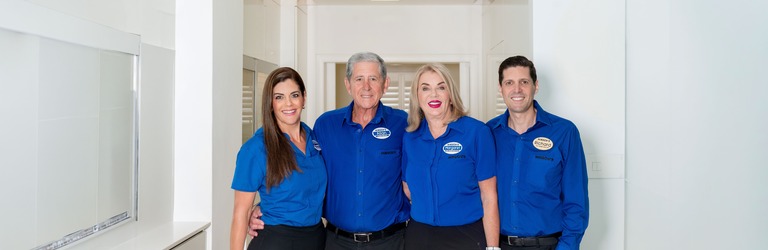
But the journey began far more humbly. Luci and Richard Hirsch, the founders’ children, who have firmly established themselves as part of the brand share the Hirsch growth story.
Seeing opportunity where others saw a problem
In 1979, Hirsch's founder Allan Hirsch was an appliance technician with what Luci Hirsch describes as roughly a Grade 9 education. He spent his days repairing appliances. Through that work, he noticed a simple but powerful opportunity. “When an appliance could not be repaired, customers still needed a solution,” Luci explains.
Rather than walking away from the customer, Allan began sourcing replacement appliances and delivering them directly to customers. At home, his wife Margaret played an equally important role. While Allan focused on sales and repairs, Margaret learned how every appliance worked and personally taught customers how to use them. That combination of technical expertise and customer care would become the foundation of the Hirsch's business model. "They were just trying to make sure the next customer was happy," says Luci. "That's what they tried to do."
The ambition was not to build a national retailer. The ambition was simply to solve customer problems. As it turned out, that was enough.
Growing up inside the business
For Richard and Luci Hirsch, Hirsch's is not just a company. It is part of their family history. The business was woven into daily life from the very beginning. After school, Luci remembers helping complete deposit slips before walking to the local Standard Bank branch to deposit the day's takings. She can still recite the company's bank account number from memory. They spent countless hours in stores answering telephones, tagging products, helping customers and waiting for their parents to finish work before heading home. "We've always thought of Hirsch's as the third child," they say.
Customers watched the family grow alongside the business. Many still remember seeing Richard and Luci playing outside the original store or doing homework while waiting for their parents to close up for the day. Those formative experiences created more than familiarity with the business. They instilled a deep understanding of the sacrifices required to build one. Looking back, Richard and Luci now recognise both the challenges and the privilege of growing up inside an entrepreneurial family.
The power of relationships
One of the defining characteristics of Hirsch's has been its commitment to long-term relationships. The company's relationship with Standard Bank, for example, dates back to the very beginning. When Allan Hirsch opened the business account at the Durban North branch in 1979, the bank manager would often stop by the shop on his way home for a cup of tea and a conversation. Those relationships became a source of guidance and support as the business expanded. "We're very loyal," they expound. "It's part of our DNA."
That loyalty extends beyond banking partners to suppliers, service providers, customers and employees. As the company grew, those relationships became increasingly valuable, particularly during difficult periods (KZN floods, the riots, Covid, etc.). Having direct access to trusted people rather than faceless systems allowed the business to navigate challenges ranging from credit card fraud and payment disputes to major operational disruptions. For Hirsch's, partnerships have never been transactional. They have been strategic.
Scaling beyond KwaZulu-Natal
For many years, Hirsch's remained a proudly Durban-based business. The next major opportunity was expansion beyond KwaZulu-Natal. The move into Johannesburg represented a significant leap of faith. Richard and Luci's parents would drive to Johannesburg, live there during the week, work on establishing stores and then return home on weekends. It was a period of personal sacrifice, but one that laid the foundations for national expansion. From Johannesburg came further growth. New stores followed. New regions opened up.
Eventually, the business expanded into Cape Town and beyond. The strategy reflected a characteristic that remains central to Hirsch's culture today: when the right opportunity appears, move quickly. If most retailers are cautious about expansion, Hirsch's tends to do the opposite. "We enjoy being uncomfortable," Richard and Luci say. The company has built a culture around continuous improvement. Success is celebrated, but never viewed as an end point. "We've never arrived. We're always hungry to be better," they exclaim.
Reinvention without losing identity
One of the most significant moments in the company's modern history came in 2019. After operating as a trust for almost 40 years, the business underwent a major restructuring and converted to a private company. It was more than an administrative change. Richard describes it as the moment Hirsch's effectively became a "47-year-old start-up". “The restructuring positioned the business for its next phase of growth and coincided with a deeper financing and expansion partnership. New investments followed, supporting property acquisitions, renovations and store growth,” he explains. Importantly, the transformation happened just before one of the most turbulent periods in recent business history.
Surviving crisis after crisis
Many businesses would have struggled to survive the challenges that followed. First came Covid-19. Then came the devastating July 2021 unrest in KwaZulu-Natal. Then came floods that once again disrupted operations. For a company headquartered in Durban, the impact was particularly severe. The unrest caused significant damage to several businesses, including Hirsch's Springfield store. The site was effectively reduced to a shell. Yet what happened next became one of the defining moments in the company's history. While competitors remained closed for months, Hirsch's restored and reopened the Springfield store in just nine days. The speed of recovery reflected the culture that has driven the business for decades: urgency, resilience and a refusal to stand still. Where many saw obstacles, Hirsch's saw challenges to overcome.
Thriving in an age of digitalisation
Perhaps the most remarkable aspect of the Hirsch's story is that it continues to thrive despite operating in one of the most disrupted sectors of the economy. Consumers today can compare prices instantly, order products online and access endless alternatives with a few clicks. Yet Hirsch's has not responded by trying to become purely digital. Instead, it has doubled down on what technology cannot easily replicate:
- Human expertise
- Personal service
- Trusted advice
- Relationships.
The company invests heavily in training and culture. Every employee undergoes induction designed not only to teach product knowledge but to instil what the company calls the Hirsch's way of serving customers. Internally, they refer to the process as being "Hirschified". Staff are trained on how to greet customers, how to engage them and how to create an experience that keeps them coming back. The philosophy is simple. "We always say we want happy customers who return often," they say. In a world increasingly dominated by automation, Hirsch's continues to compete by making service its differentiator.
A business built for future generations
Perhaps the clearest indication of Hirsch's long-term mindset emerged during its recent corporate restructuring. The family created a new company structure, but it remains a family business. Today, Allan and Margaret may be officially retired, but they remain actively interested in the business they built. Regular meetings, discussions and advice sessions continue, ensuring that decades of entrepreneurial wisdom are never far away. As Richard puts it, they represent the practical, street-smart version of business education. The kind learned through experience rather than textbooks.
The next chapter
After 47 years of growth, Hirsch's shows little sign of slowing down. New stores continue to be developed. New opportunities continue to emerge. New generations are preparing for their future careers. Yet despite its scale, the company's ambitions remain remarkably similar to those of its founders:
- Serve customers better
- Offer greater value
- Build stronger relationships
- Keep improving
- Never become complacent.
In an age where businesses are often consumed by technology, Hirsch's offers a different lesson. Digital transformation matters, but sustainable growth is still built on human connection. Nearly five decades after a technician began selling replacement appliances to customers whose products could not be repaired, that principle remains at the heart of everything Hirsch's does. And perhaps that is why the company continues to grow, one customer, one relationship and one opportunity at a time.
Find out more about how you can amplify your growth with Standard Bank Business and Commercial Banking.