Change of banking details scams: How to spot and stop them
Learn how to spot a change of banking details scam and how to protect yourself.
Making payments has become faster and more convenient than ever. Whether you’re paying a supplier, purchasing a car or settling an invoice, digital banking helps life move quickly. Unfortunately, scammers take advantage of this by tricking people into paying money into the wrong account through fake banking detail changes. These are known as change of banking details scams.
At first glance, the request may look legitimate. Emails can appear professional and familiar, but fraudsters are manipulating payment details to redirect funds into their own accounts.
The good news is that a few careful checks can go a long way in protecting your money.
What is a change of banking details scam?
This type of scam happens when a fraudster pretends to be a trusted person or business and asks you to update banking details before making a payment.
The scammer may pose as the following:
- A supplier
- An attorney
- An estate agent
- A contractor or service provider
- A car seller or dealership
- Even someone within your own business
In many cases, criminals gain access to email conversations and monitor communication for weeks before striking. Once they identify an upcoming payment, they send updated banking details that redirect the money into a fraudulent account.
By the time the fraud is discovered, the funds may already have been withdrawn or moved.
Why these scams are so convincing
Scammers rely on more than technology. They also exploit trust, urgency and distraction.
A fraudulent email might do the following:
- Use the same branding, logos and signatures as a legitimate business.
- Copy the writing style of someone you know. The message will typically include the following: ‘We’ve changed our bank account details.’ ‘Please use the new account for future payments.’
- Refer to a real invoice or ongoing transaction.
- Create urgency by saying payment is overdue or must be made immediately.
The goal is to get you to pay quickly before you check whether the change is real.
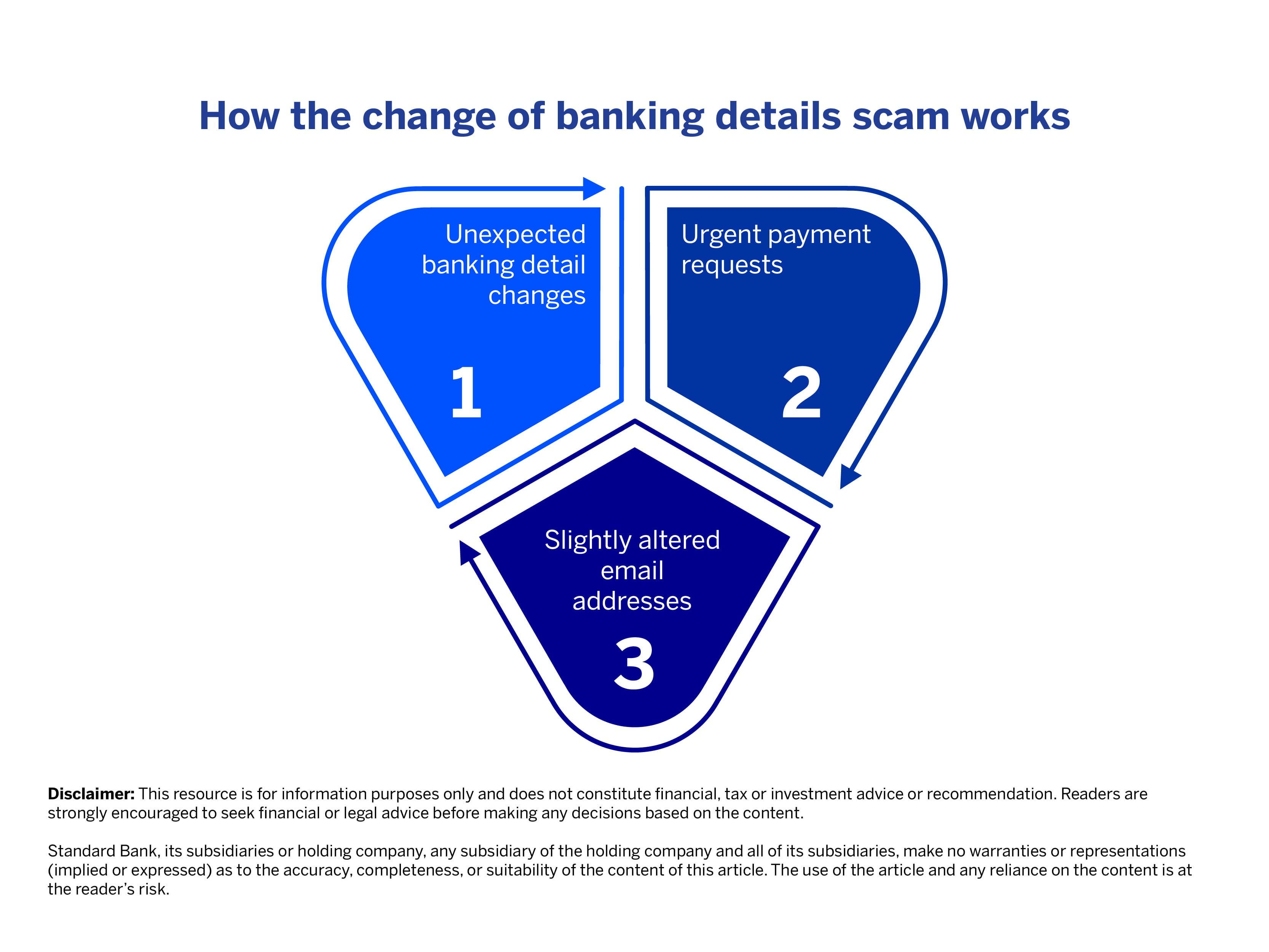
How the scam works
1. Unexpected banking detail changes
2. Urgent payment requests
3. Slightly altered email addresses
Stop and always verify banking changes through a trusted channel.
Some fraudsters even make small changes to email addresses that are easy to miss at a glance, for example:
- .co.za instead of .com
- A missing letter
- An extra character
- A subtle spelling variation
- A number instead of a letter (O and 0)
Even if the request appears genuine, it’s important to pause and verify before making payment.
How to protect yourself before making payment
A few simple habits can significantly reduce your risk.
1. Always verify banking detail changes
Contact the business or person using a number you already have on file, not the one in the email. Avoid using phone numbers or links provided in the suspicious email itself.
2. Check the email carefully
Look beyond the display name and inspect the full email address carefully. Small changes are often used to impersonate legitimate businesses.
3. Compare the account holder name
Make sure the account name matches the company or individual you expect to pay.
4. Be careful with attachments
Some scam emails include fake invoices or forms designed to look official.
5. Slow down the urgency
If the message is urgent, that is even more reason to verify it.
6. This helpful rule is simple
Never rely on one message alone to change payment details.
You can also use Account Verification Services (AVS) to verify bank account details and, if you’re using the Banking App, you can follow our step-by-step guide on how to do it here.
Keep up to date with the latest banking scams
Businesses are also targets
These scams don’t only affect individuals. Small businesses and large organisations are frequently targeted because of the volume and value of payments processed daily.
Fraudsters may target finance teams, suppliers or payroll departments to redirect payments or salaries.
Businesses can strengthen protection by doing the following:
- Training staff to recognise payment fraud
- Using approval processes for banking detail changes
- Verifying changes telephonically
- Limiting access to sensitive payment information
- Using secure email and cybersecurity measures
If you’ve received a suspicious request, stop before paying and verify the details using a trusted contact method.
| If you suspect you've been targeted by a scam or that you’ve been the victim of fraud on your bank accounts, call the Standard Bank Fraud Line on 0800 222 050 or report fraud on your Banking App: 1. Tap on Help 2. Select Report Fraud 3. Follow the prompts |
Disclaimer: This article is for information purposes only and does not constitute financial, tax or investment advice. Readers are strongly encouraged to seek financial or legal advice before making any decisions based on the content.
Standard Bank, its subsidiaries or holding company, any subsidiary of the holding company and all of its subsidiaries, make no warranties or representations (implied or expressed) as to the accuracy, completeness, or suitability of the content of this article. The use of the article and any reliance on the content is at the reader’s risk.
Related articles and media