
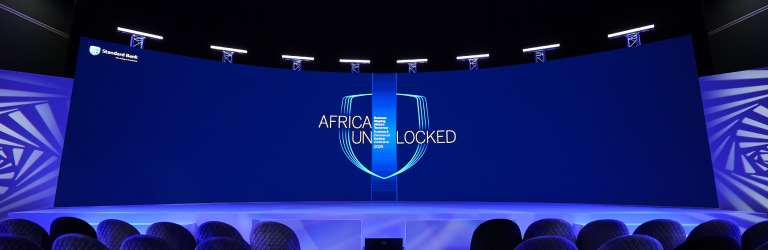
Rethinking Africa’s economic narrative: Power, perception and progress
Resetting the narrative: Advancing Africa’s economic sovereignty and unlocking SME growth
In a world where perception shapes capital, trust drives investment and stories spark transformation, Africa is rewriting its economic narrative. The Resetting the Narrative panel at Africa Unlocked 2025 tackled one of the continent’s most strategic imperatives: rebranding Africa as a credible, innovative and high-growth player in the global economy.
The cost of a distorted image
Africa has long battled with entrenched perceptions that frame the continent as unstable and high-risk, despite evidence to the contrary, so much so that the panel on resetting the African narrative opened up with a laundry list of narratives that have been prevalent, certainly in South Africa, for the last decade.
These legacy views have created what could be described as narrative inertia, creating a persistent, outdated framing of the continent as unstable, risky and opaque. This is more than a reputational problem. It is costly. The panel tone took a shift when countered with insights on demographics, and client sentiment with Sim Tshabalala, CEO of Standard Banks Group stating, “We believe that there are opportunities to make money.”
Africa storytelling in business and sovereignty
One of the panel’s most compelling themes was the notion that economic sovereignty cannot be separated from narrative sovereignty. Telling your own story, accurately and powerfully, is an act of self-determination.
Dr Agnes Kalibata showcased this by breaking down some misconceptions around the African narrative, “In the last 30 years, African agriculture has grown by 400 million tonnes every decade. In the last 30 years, we've grown from 400 million to 1.2 billion metric tons, so if you think this sector is not growing, it's not true.”
She continued, “The next myth that I would like to bust: African businesses are small—$300 000, $500 000—but they are by no means doing small business in agriculture. They are moving. Of the 1.3 billion metric tons that Africa produces every year, 1.1 billion is moving. It's not consumed where it's produced.”
She went on to explain that we have also erroneously believed the narrative that our biggest agricultural opportunity is agricultural export, stating, “Our food market is 10 times the size of our export market.”
She told the story of agriculture and economy in Africa from the perspective of narrative and sentiments, starting with misguided beliefs and ending with a note of hope of where we can add value.
From this panel, we know that this much is true: Africa’s business and policy leaders are using storytelling as a strategy. At Standard Bank, for example, we have produced a range of entrepreneur-focused video series through our BizConnect platform, spotlighting real-life founders and business leaders across the continent. These stories serve not only to inspire but to reframe Africa’s business image, from deficit and dependence to innovation, growth and agency.
Rebranding Africa globally
Across sectors, the conversation is shifting from aid to agency. Rather than seeking sympathy, Africa is claiming its role as a dynamic driver of global growth.
This repositioning includes systemic reform and strides towards a major perception shift in African markets. The African Union and UN Economic Commission for Africa are championing the development of the African Credit Rating Agency (AfCRA), a continent-led institution designed to improve transparency, offer contextual insights and counterbalance external bias in sovereign ratings (UNECA, 2025).
Sim Tshabalala believes that we need a media narrative that reflects what’s happening on the ground, not outdated headlines, adding, “Ratings agencies need to have more people on the ground on the continent, more people participating in the formulation of the models, both the evaluative ones and the credit decision-making processes.”
This initiative is not just about technical adjustments; it’s about reshaping how the world sees African economies.
SMEs as Africa’s economic heartbeat
A recurring point in the panel was that small and medium enterprises (SME) are not side projects; they are the main act. According to the World Economic Forum (2023), SMEs account for 95% of all registered businesses and contribute about 50% to the total GDP of sub-Saharan countries (Muriithi, 2017), yet they are often excluded from the macroeconomic story.
Dr Agnes Kalibata highlighted the demographic reality that 77% of the population was under 35. She emphasised that if a major economic sector such as agriculture didn't include these young people, it presented a significant problem. Furthermore, she noted that new technologies were increasingly driven by young individuals, and therefore, the agricultural sector was actively working to create spaces that fostered the inclusion of young people.
This story is now the driver for many African businesses, supported by the edge that technological adaptation offers: ‘The digital marketing sector has contributed to the empowerment of small and medium-sized businesses (SMEs) in Africa in creating powerful narratives to boost sales and reach new audiences.’ (Nmesoma, 2025).
Entrepreneurs across the continent are increasingly using storytelling, digital platforms and peer-led visibility to shift how local businesses are perceived by funders, partners and policymakers alike.
A story the world needs to hear
Africa is not asking for charity; it is demanding fair lenses and balanced narratives. As the panellists at Africa Unlocked 2025 made clear, economic progress begins not only with capital or infrastructure but also with belief.
"We believe that pessimistic nations are dangerous nations, and pessimistic people are dangerous people. You need to be sceptical and analytical, which is what our risk managers do, but they too remain optimistic” explained Sim Tshabalala. He added that both pessimism and optimism are choices and that “At Standard Bank, we choose to be optimistic.”
Belief in the people, in the vision and in the truth of Africa’s evolving story and belief, too, that it is a story worth investing in.