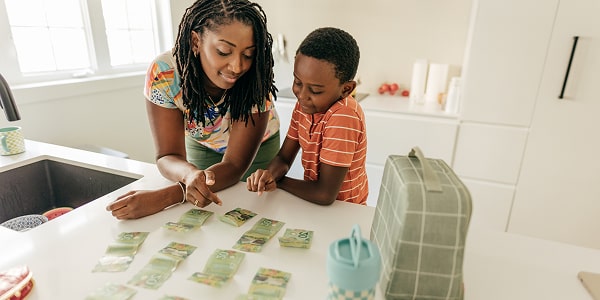
Why should my child have their own bank account?
You’ve probably had the money talk probably more than once, yet your child still manages to spend all their pocket money by Tuesday and asks for more by Thursday. The thing is, talking about money only goes so far. Kids learn best by doing. And the earlier you start, the better.
Research suggests children's money habits begin taking shape as early as age seven, so it's a good idea to start having money conversations as soon as possible.
A bank account teaches something a classroom simply can't – what money feels like. Watching a balance go up. Watching it go down. Wanting something and not having enough yet.
This builds three habits that, honestly, many of us adults are still figuring out:
- Needs versus wants
Most kids want everything – the sneakers, the slime kit, the game. But when it’s their own money, they quickly start to figure out what they actually need vs what they really just want. - Money runs out
A child who spends their whole week's pocket money on Monday and has nothing left for the weekend has learnt a lesson no parent could teach them. Let it happen. It's a cheap lesson now, but it becomes an invaluable one later in life. - Patience pays off
Three weeks of pocket money buys a chocolate and a cooldrink. Three months of saving that pocket money buys the sneakers. When kids can see their balance growing towards something they want, saving suddenly starts to make sense, especially when there are real rewards along the way.
Pocket money becomes the lesson
Here’s the problem with cash: it disappears. R20 gets pocketed, spent at the tuckshop, and that’s it. The chocolate is gone and so is the money, with nothing to show for it.
A bank account makes money habits visible. By putting their pocket money straight into an account, they can see their balance, track what they’ve spent, and start to notice their own patterns. Do they spend everything at once? Try to save? Run out by Wednesday? They’ll learn to work it out themselves, which is the whole point.
That's where a (sum)1 account quietly does the teaching for you. No monthly service fees, all the benefits of a bank account, and built-in money lessons you don’t need to plan. Switch on MyUpdates and, when the notification comes in, just ask: "What was that for?".
Your child will need to think about what they spent, why they spent it, and whether it was worth it. All from one question you asked while making supper.
Try a long-weekend “money challenge”
Long weekends are a great place to start. Give your child a small holiday budget in their (sum)1 account, even R50, and let them be in charge. Treats, activities, small spends ... their call. Runs out on day one? That's the lesson. Lasts all four days? Tell them you noticed.
For older kids, take it a step further. Before the weekend, sit down together and draw up a budget – you could even introduce them to the 50/30/20 rule: 50% for needs, 30% for wants, and 20% to save. It’s the same thing financial advisors tell adults to do, and the earlier it becomes a habit, the easier it gets.
And when they do save their money, there's something in it for them. (sum)1 account holders get access to Junior Perks, an exclusive deals platform with discounts at some of SA's coolest food spots, stores and entertainment venues. Suddenly, saving has an upside your kids can get excited about.
Terms and conditions apply.
Disclaimer: This article is for information purposes only and does not constitute financial, tax or investment advice. Readers are strongly encouraged to seek financial or legal advice before making any decisions based on the content.
Standard Bank, its subsidiaries or holding company, any subsidiary of the holding company and all of its subsidiaries, make no warranties or representations (implied or expressed) as to the accuracy, completeness, or suitability of the content of this article. The use of the article and any reliance on the content is at the reader’s risk.
Related articles and media