
Smart starts: Reasons to involve kids in banking
Equipping children with the skills for a confident future is a priority for every family, and financial understanding is a crucial part of this effort. Imagine transforming money management from a potential worry into an empowering, shared learning experience for everyone.
By embracing banking as a collaborative family activity, we naturally foster open communication about finances. This builds not only a foundation of financial literacy but also trust and a sense of security, both in the parent-child relationship and in preparing the child for a financially confident future.
Fostering financial literacy from a young age
The sooner children learn about money, the more financially fluent they can become and the better their financial wellbeing can be in adulthood. Being collaborative provides a tangible, real-world classroom but one where the stakes are much lower.
When children observe parents managing finances either by visiting a bank or on a banking app or online, they understand that there is a flow to money (i.e. seeing digital transfers, noticing new deposits or learning how savings accrue interest) and that finances are something active and intentional: it isn’t an endless or idle resource but rather a tool to be managed wisely.
Promoting open communication
By involving children in banking activities, parents demystify finances and encourage open dialogue about income, expenses and financial goals. This transparency fosters trust and can help children understand the family's financial situation (at an age-appropriate level), leading to more responsible requests and a greater appreciation for the value of money. It also breaks down the taboo around discussing finances, preparing them for healthier financial conversations in their own future relationships.
Teaching practical money skills
Directly involving children in practical banking activities, such as visiting a branch or tracking online balances, transforms abstract financial concepts into concrete, understandable realities that will equip them with the fundamentals of managing money, for example, learning how to read statements, understanding transaction types and understanding the power of compound interest.
Cultivating responsibility
Having their own bank account instils a sense of autonomy and responsibility in a child. This hands-on experience allows them to grasp fundamental financial concepts such as earning, saving and spending in a tangible way and helps them recognise that they are able to achieve a financial goal. The process also helps them understand the impact of deliberate choices, consequences, prioritising spending and developing self-control and surety.
Financial confidence shapes future financial independence
Equipping children with practical financial habits from an early age is an invaluable gift for their future. Family banking provides this essential groundwork that can help them navigate their financial journey. Children who grow up understanding how the financial system and managing money works are less likely to fall prey to common financial pitfalls later in life. That means they’ll be better prepared to handle credit and investment opportunities and approach major purchases and milestones with confidence.
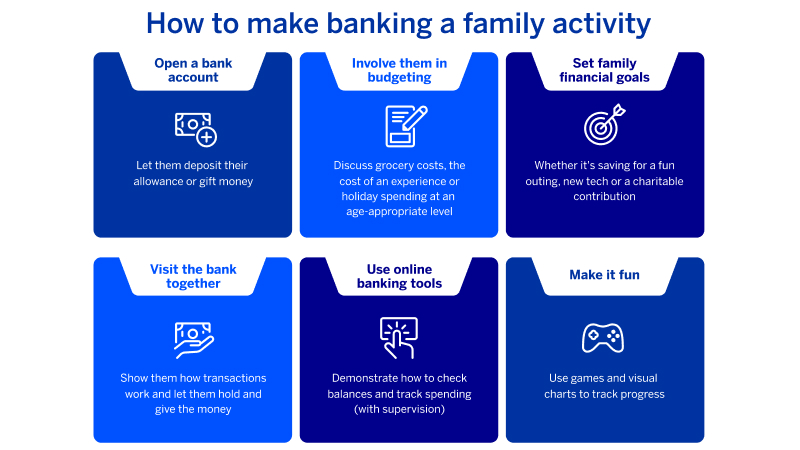
Enjoy a banking experience that supports the whole family
Our suite of Private Banking accounts gives you access to a free bank account for your children and a discounted secondary bank account for your spouse. Making it easy to meet the entire family’s unique banking needs and helping your family achieve its shared financial goals.
Terms and conditions apply.
Disclaimer: This article is for information purposes only and does not constitute financial, tax or investment advice. Readers are strongly encouraged to seek financial or legal advice before making any decisions based on the content.
Standard Bank, its subsidiaries or holding company, any subsidiary of the holding company and all of its subsidiaries, make no warranties or representations (implied or expressed) as to the accuracy, completeness, or suitability of the content of this article. The use of the article and any reliance on the content is at the reader’s risk.
Related articles and media